You’re getting more done with AI. You’re not getting better.
Letter 9 · Sep 7, 2026 · 14 min
I dictate a task to a model. I read the answer. I shout at the screen.
Fix it. This is garbage. Do it properly.
I get angry at it as if it were supposed to answer for this. It wasn't. I was.
I know this closer than any study. Most of the texts in my archive were generated. They stand under my name, but not every thought in them passed through me.
The model didn't take this. I handed it my thinking.
I call this the handover. It does not start when the model does something. It starts when I stop knowing which decision, in the end, was still mine.
This text is for those who get more done with AI and get more tired. I use it every day too. So I was looking not for proof that "AI hurts," but for the point from which we started calling a human's absence progress.
One of the benchmarks already expresses this progress in minutes without a human. For Claude Opus 4.5, on its set of technical tasks, METR put the number at 320.
To understand where this measure came from, I opened a proposal for $13,500, ten people, and one summer. There was not a single word in it about an assistant.
I. At first the machine had to prove that we understood thought.
Dartmouth proposal, 31 August 1955
Every aspect of learning or any other feature of intelligence can in principle be so precisely described that a machine can be made to simulate it.
Summer 1956, Hanover, New Hampshire. Ten people were supposed to gather at Dartmouth College for two months on Rockefeller Foundation money. The proposal had been written a year earlier, and it is still in the open. I opened the document myself.
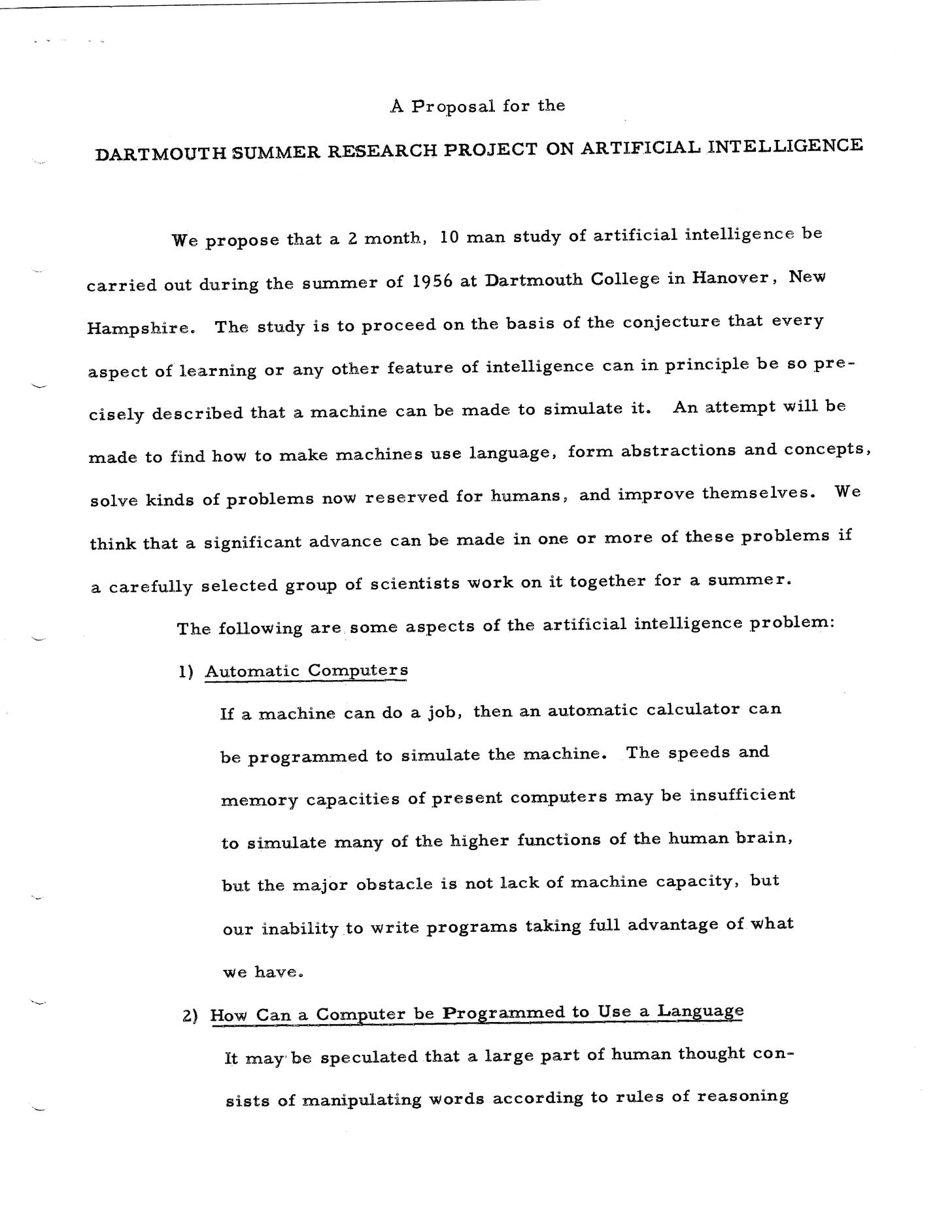
Then the proposal lists: teach a machine to use language, form abstractions, solve problems that until then only people could solve, and improve itself.
Notice what is not on the list.
There is no assistant. There is nobody you can hand a letter, a decision, or a whole workday. The aim was to understand how intelligence works, precisely enough to reproduce it. Simulation was supposed to be proof of understanding.
This is the first measure in this story. A measure is whatever a given system treats as success. Here, success was understanding a phenomenon well enough to describe it to a machine.
Under the proposal there are four signatures: John McCarthy, Marvin Minsky, Nathaniel Rochester, and Claude Shannon.
Shannon is worth lingering on. In 1948 he made information a measurable quantity and gave it a unit, the bit. Two years later he built an electromechanical mouse named Theseus.
On the first pass, Theseus moved through the maze by trial and error. It hit a wall, changed direction, stored the error. When it was put back at the start, it already knew the route to the exit.
Get the next letter
Free. Letters arrive from Substack.
Continue this letter on Substack Twelve more minutes.